



One of the main concerns for anyone considering a move to Paraguay with family is children’s education.
Are there good schools in San Bernardino? Are they public or private? How does the school system work? How much does it cost? Can Brazilian children keep up with classes in Spanish?
After researching the schools in town and living the experience myself with five children, I put together this overview to help other families — especially Brazilians and other foreigners thinking about living in San Bernardino.
Overview of schools in San Bernardino
San Bernardino does not have as many schools as larger cities such as Asunción. The education network is made up mainly of public schools, spread between the town center and different neighborhoods in the district.
Among the institutions are Juan Enrique Pestalozzi, Ramón I. Cardozo, Defensores del Chaco, Adela Speratti, Máximo Jiménez Hernández, Sigfrido Gross, Milner Buey Cataldo, Elvira R. de Balbuena, and Cristóbal Colón.
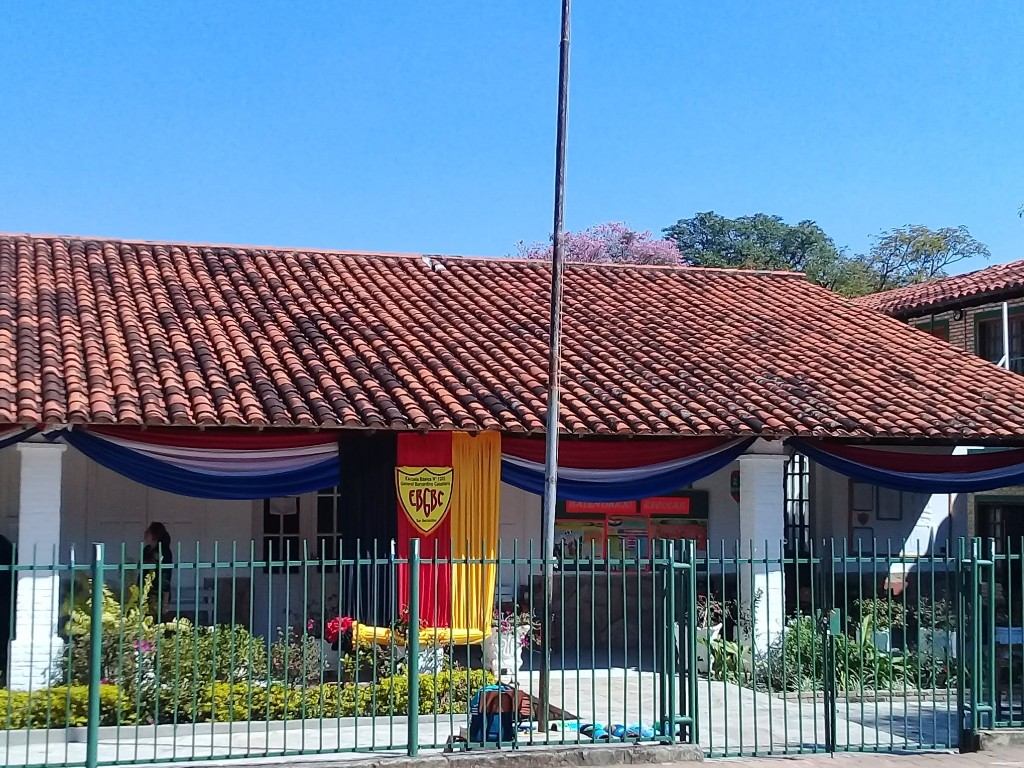
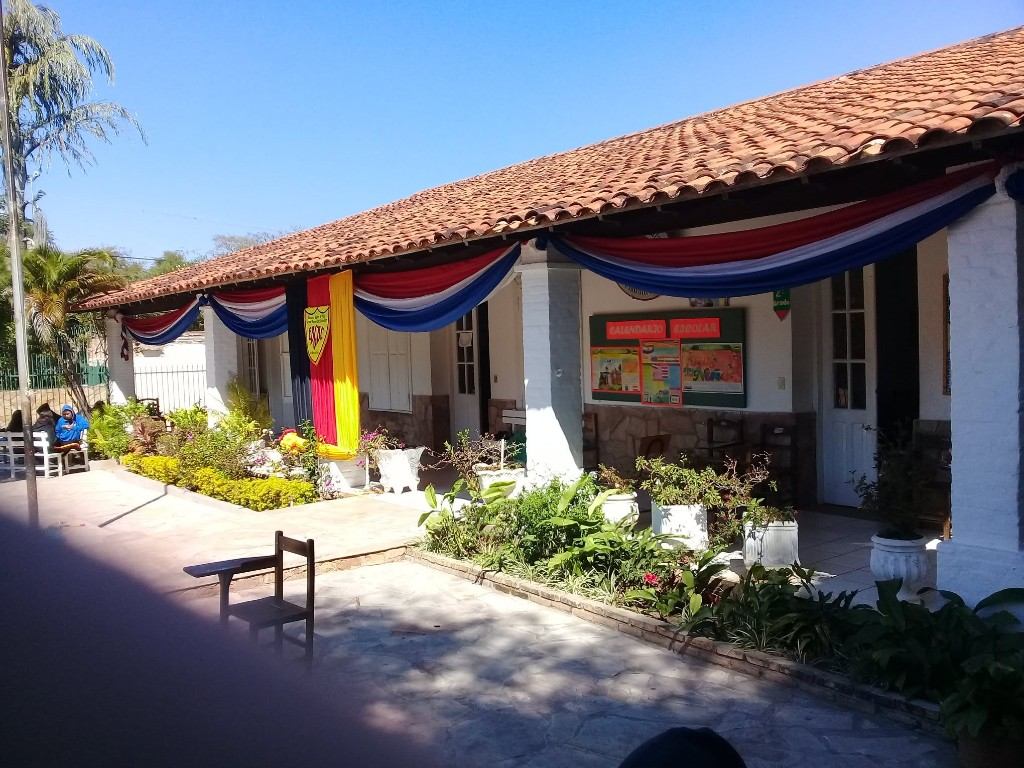
The only private option identified in town is Colegio Privado General Bernardino Caballero, which operates as a privately run, government-subsidized school (*privado subvencionado*).
The town also has Colegio Técnico San Bernardino, a public institution that offers Educación Escolar Básica (basic school education) and Bachillerato Técnico (technical secondary education) in Accounting and Hospitality & Tourism.
A little farther out — about 20 minutes from the center of San Bernardino — there is also Escuela Básica N.º 1203 Patria, located in Altos. It also operates as a privately run, subsidized school.
How schooling works in Paraguay
For people coming from Brazil, the names of the school stages can be confusing at first.
In simplified terms, the system is organized like this:
- Preescolar — equivalent to preschool / early childhood education;
- 1st through 9th *grado* — corresponding to Educación Escolar Básica (basic school);
- 1st, 2nd, and 3rd *curso* — corresponding to Brazilian upper secondary school (*Ensino Médio*).
When a school says it goes up to the 3rd *curso*, it means it teaches through the final year of secondary education.
Public, private, and privately subsidized schools
In Paraguay, schools may be official (public), private, or privately subsidized (*privadas subvencionadas*).
An official school is public and run by the state. A private school is run by a private institution and depends mainly on tuition paid by families.
A privately subsidized school is also privately administered, but it receives some form of government financial support, which may include operating funds or teachers paid by the state.
That does not mean the school is free. It may charge enrollment fees, monthly tuition, and other contributions. Because part of the costs is covered by the government, however, fees are usually more affordable than those of a fully private school.
That is the case with Colegio Privado General Bernardino Caballero.
A father’s view with five children in San Bernardino
My five children attend Colegio Privado General Bernardino Caballero.
I have an 8-year-old son, two 11-year-old girls, a 14-year-old daughter, and a 17-year-old son. That lets me see the school across different stages, from the early *grados* through secondary education.
Based on our experience, I consider the school to be of very high quality — especially when you weigh the curriculum, the welcome, the activities, and the fees.
The school serves students from preescolar through the 3rd *curso*. My younger children started there in 1st *grado*, and my oldest is expected to take the 3rd *curso* next year.
A broad subject offering
The school has a broad curriculum, with subjects such as Spanish, mathematics, biology, chemistry, Guaraní, English, and German.
Beyond the traditional subjects, there is also content focused on practical life skills.
My 8-year-old, for example, already has classes related to health, family, and living together. In those lessons, children learn basic ideas about hygiene, respect, behavior, how to treat others well, and how not to invade other people’s space.
The 11-year-old girls have introductory economics content. They learn basic notions about money — how to use it, how to save, and how to take better care of their own resources.
In health-related classes, they study hygiene in more depth, as well as illnesses, prevention, and basic care that matters in everyday life.
As students move up through the *grados*, these topics become more complete. Older students go deeper into illness, prevention, and personal care.
It is not only about preparing for tests. There is a real concern with teaching knowledge that children and teenagers can actually use throughout life.
The school also strongly reinforces values such as discipline, responsibility, and civility. Students line up to enter, sing the anthem, and learn to respect the school’s organization. Older students also help younger ones, creating a structure that encourages collaboration, respect, and a sense of responsibility.
Arts and cultural activities
The school has an agreement with Centro Cultural Casa Hassler.
Through that partnership, students can take part in activities such as dance, music, guitar, and other artistic classes.
That contact with the arts complements traditional schooling and gives children opportunities to discover new interests and develop different skills.
Sports at Club Náutico
Another standout is the agreement with Club Náutico San Bernardino, which sits behind the school.
Children do Physical Education activities on the club grounds, using facilities that would rarely be available inside a small school.
Beyond sports, the school organizes outings to different places and keeps a busy calendar of parties, performances, celebrations, and school events.
There is always some activity being prepared by the school, the teachers, or the families.
Parent involvement
One of the things that most impressed us was how involved families are.
Parents are very present in school activities and daily life. They help with events, parties, materials, and projects throughout the year.
That involvement creates good interaction among parents themselves and among the children as well.
For a family that has just arrived in a new town and a new country, that sense of community makes a real difference. It helps not only with school adaptation, but also with making friends and integrating into local life.
How foreigners are welcomed
Our Brazilian family was extremely well received.
The school already has experience with foreign students. There are German, French, and Paraguayan families — and now our Brazilian family as well.
In general, teachers, staff, parents, and students understand Portuguese reasonably well. When someone does not understand something, they use a translator or find another way to communicate.
The team has always been helpful, patient, and open to our children’s needs.
Of course, studying in another language requires an adjustment period. Even so, our children were never left aside because they were not yet fluent in Spanish.
How long did it take my children to adapt?
Every child has a different personality. That is why the adaptation time also varied quite a bit.
8-year-old son
My 8-year-old took about three weeks to feel well settled.
In that period, he was already communicating with classmates, playing comfortably, and inviting school friends over to our house.
After about four or five months, he started speaking Spanish with ease. He was not fully fluent yet, but he could communicate, play, take part in class, and explain what he needed.
11-year-old girls
The 11-year-old girls took about a month to adapt fully.
By the second week they already had friends. Getting used to the teacher, the routine, the language, and the environment, however, took roughly a month.
After five or six months, they were speaking almost everything in Spanish and communicating normally.
14-year-old daughter
My 14-year-old daughter is quite shy and tends to keep to herself. Because of her personality, the process took a little longer — about two months.
When she made a close friend who became one of the best friends of her life, everything changed quickly. She began to feel much more comfortable and included.
After about seven months, she could communicate fully in Spanish without major difficulty.
Oldest son
My oldest son entered the school at 16 and is now 17.
He had already taken Spanish courses, so his adaptation was very fast. In three or four days he was already integrated with classmates and school routine.
There is one more important detail: the other children started at the beginning of the school year, while he stayed a little longer at his previous school and joined the Paraguayan school mid-year.
Even arriving after groups had already formed, he was warmly received and settled in quickly.
Tuition, enrollment, and books
Cost is another strong point.
In the more expensive years, monthly tuition is about Gs. 400,000 per child, plus an enrollment fee of roughly Gs. 300,000, paid on entry.
Because the school is subsidized, most books are provided by the government. In 2026, we spent a little more than Gs. 150,000 per child on complementary books for the whole year.
There are also small contributions for printing, materials, parties, uniforms, clothes for performances, outings, and specific activities.
I do not have the exact uniform costs, but they were much cheaper than what we were used to in Brazil.
Even adding those expenses together, we consider the overall cost very affordable given the quality of teaching and the range of activities offered.
Our conclusion
Before moving to Paraguay, one of our biggest concerns was our children’s education.
We did not know how they would be received, how long it would take them to learn Spanish, whether they would keep up with the subjects, or whether they would struggle to make friends.
Today we can say the adaptation went much better than we expected.
Each child had their own pace. Some settled in within a few days, while others needed a few weeks or months. Still, all of them made friends, learned Spanish, took part in activities, and found their place at school.
San Bernardino does not have a wide range of private schools. Most institutions in town are public, and General Bernardino Caballero is the main privately subsidized option in the city.
In our case, the school was able to serve five children of different ages, personalities, and grade levels.
We found quality teaching, several languages, cultural activities, sports, family involvement, a warm welcome for foreigners, and very accessible fees.
This text is not a ranking of the town’s schools, and it does not mean other institutions are not good. It is simply an honest account from a Brazilian father with five children studying in San Bernardino.